The Fading Light and the Enduring Word: A Call to Spiritual Vigilance
Scripture Reading: Hebrews 3:7-19; Romans 10:17; Psalm 119:105
My dear brothers and sisters in Christ,
We gather today in a world that often feels adrift, a society grappling with moral confusion, and an age where the very foundations of truth seem to be shifting. And within this landscape, we, as believers, are not immune to the subtle, yet profound, dangers that threaten our spiritual vitality.
Today, I want to speak to you about a peril that can creep silently into our lives, a danger that, left unaddressed, can lead to a dimming of our spiritual light: the danger of spiritual decline.
Imagine, if you will, a lighthouse on a rocky coast. Its beam, once strong and unwavering, cuts through the darkest storms, guiding ships safely to harbor. But what if, over time, that light began to flicker, to wane, to lose its intensity? What if the keepers grew complacent, neglecting the fuel, ignoring the necessary maintenance? The consequences, as you can imagine, would be catastrophic. Ships would lose their way, crashing against the rocks, lives would be lost.
In much the same way, our spiritual lives are meant to be lighthouses in a darkened world. We are called to reflect the light of Christ, to be beacons of hope and righteousness. But spiritual decline, this gradual erosion of our faith and fervor, can dim our light, making us ineffective and leaving us vulnerable to the moral storms that rage around us.
How does this decline begin? Often, it’s not with a sudden, dramatic fall, but with a subtle drift. It’s the missed quiet time, the neglected prayer, the casual
indifference to gathering with fellow believers. It’s the slow erosion of our hunger for God’s presence, the quiet turning away from the very source of our spiritual life.
The author of Hebrews, in the passage we read, issues a stern warning to the early believers, a warning that echoes powerfully across the centuries to us today. He speaks of the Israelites in the wilderness, whose hearts were hardened by unbelief, who refused to hear God’s voice, and as a result, failed to enter into His rest. He cautions us, “Today, if you hear his voice, do not harden your hearts as you did in the rebellion.”
This hardening of the heart is the insidious fruit of spiritual decline.
When we stop listening, when we stop engaging with the divine, our hearts become calloused, our spiritual senses dulled. We lose our sensitivity to sin, our compassion for others wanes, and our commitment to truth becomes negotiable. The lines between right and wrong blur, and we find ourselves adrift in a sea of moral ambiguity.
And what is the natural consequence of this spiritual drift?
A weakening of our moral compass. Our actions are a reflection of our hearts. If our hearts are growing cold towards God, our lives will inevitably begin to reflect that coolness. We may find ourselves compromising on our values, indulging in what we once considered unacceptable, and losing the inner strength to resist temptation. The very foundation of a moral life – a life lived in accordance with God’s will – begins to crumble.
But there is hope! There is a remedy for spiritual decline, a powerful antidote to the hardening of hearts, a constant source of strength to build and maintain a
vibrant, moral life. And that remedy, that power, is found in the continued hearing of the Word of God.
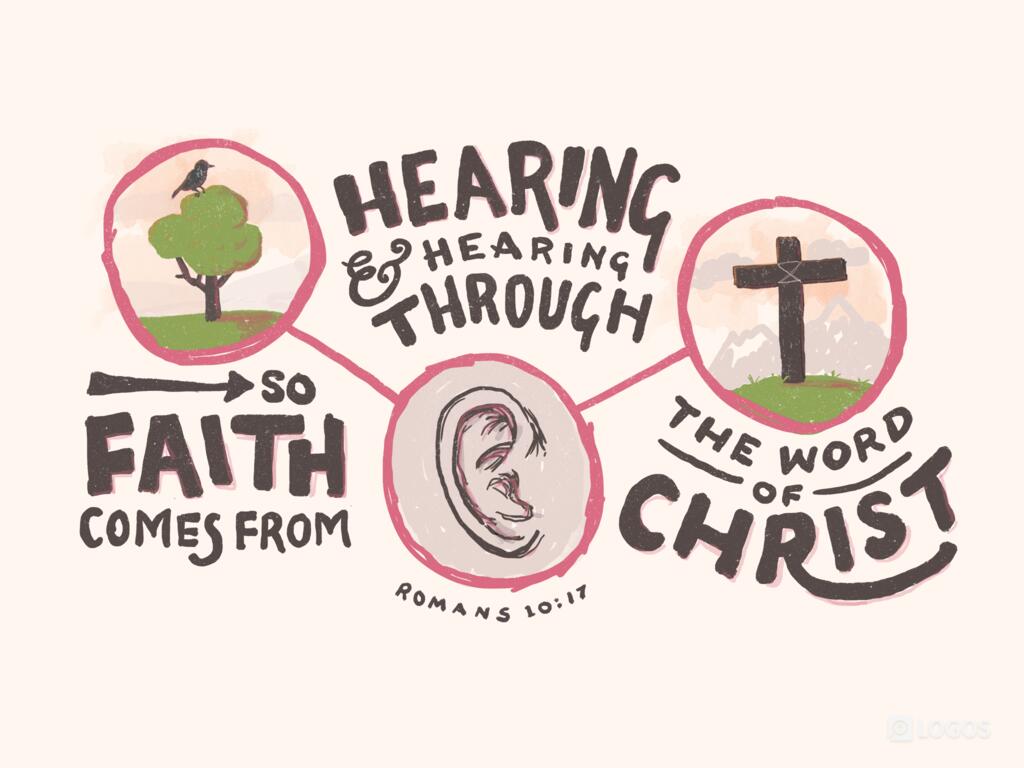
Romans 10:17 declares, “So then faith comes by hearing, and hearing by the word of God.”
This is not just a theological statement; it is a profound spiritual truth. Our faith, the very bedrock of our relationship with God and the wellspring of our moral choices, is built and nourished by God’s Word.
Think of it like this: If faith is a muscle, then God’s Word is the consistent, strengthening exercise it needs. Just as a physical muscle atrophies without use, our faith weakens without the regular intake of God’s truth.
Psalm 119:105 tells us, “Your word is a lamp to my feet and a light to my path.”
In a world shrouded in darkness, God’s Word is our illuminating guide. It reveals truth, exposes error, and directs our steps towards righteousness. When we are immersed in His Word, our vision becomes clearer, our discernment sharper, and our path more defined.
How does hearing the Word of God build faith and maintain a moral life?
It reveals God’s character and His will: As we read and listen to the Scriptures, we gain a deeper understanding of who God is – His holiness, His love, His justice, His mercy. This knowledge transforms our perspective and aligns our desires with His. We begin to see the world through His eyes, and His will for our lives becomes clearer.
It convicts us of sin and points us to repentance: The Word of God is like a mirror. It reflects back to us not only God’s perfect standard but also our own
imperfections. It exposes our sins, our shortcomings, and our areas of spiritual compromise. This conviction, though sometimes uncomfortable, is a gracious act of God, leading us to repentance and a renewed commitment to Him.
It provides instruction and wisdom for daily living:The Bible is not just a collection of stories; it is a practical guide for life. It offers wisdom for relationships, for finances, for work, for our thoughts and attitudes. It teaches us how to love, how to forgive, how to endure, and how to live in a way that honors God.
It offers hope and encouragement in times of trial: Life is full of challenges, disappointments, and heartbreaks. The Word of God is a wellspring of comfort and hope. It reminds us of God’s faithfulness, His promises, and His ultimate victory. It strengthens us to persevere, knowing that He is with us through every storm.
It empowers us to live righteously: The Word of God is not merely informative; it is transformative. As we internalize its truths, the Holy Spirit works within us, empowering us to live out what we have learned. It equips us to resist temptation, to choose righteousness over compromise, and to walk in obedience to God’s commands.
My friends, the antidote to spiritual decline is not a secret formula or a complex ritual. It is a simple, yet profound, commitment to consistently hear and heed the Word of God.
It means: Prioritizing personal time in the Scriptures: Not just skimming, but meditating, studying, and allowing God’s voice to speak to your heart. Actively engaging with the preached Word: Coming to church not as passive spectators, but as hungry listeners, eager to receive nourishment from the sermon. Participating in Bible studies and small groups: Learning from others, asking questions, and deepening your understanding of God’s truth in community. Memorizing and meditating on Scripture: Hiding God’s Word in your heart so that it becomes a constant source of guidance and strength.
Let us not be like the Israelites in the wilderness, whose hearts grew hardened through unbelief. Let us not allow the busyness of life, the distractions of the world, or the subtle whispers of apathy to dull our spiritual senses.
Instead, let us cultivate a profound hunger for God’s Word. Let us lean into its truth, allowing it to build our faith, sharpen our moral discernment, and empower us to live lives that reflect the beauty and righteousness of Christ.
May our spiritual lights shine ever brighter, fueled by the enduring, life-giving Word of God, guiding us and others safely through the storms of this world, and ultimately, into the eternal rest of our Lord.
Amen.



Leave a Reply